French royal army
The Three MusketeersThe French royal army is the armed power through which Louis XIII’s government confronts internal revolt, foreign intervention, and the competing authority of Cardinal Richelieu. Its most sustained appearance is in the campaign against La Rochelle in 1627, where the destruction of the last major Huguenot stronghold becomes simultaneously a religious, strategic, and dynastic project. The army’s movements also provide the framework within which d'Artagnan’s personal ambitions, dangers, and friendships acquire public consequences.
Nature and Political Position
The French royal army operates in a France where war is nearly habitual and where political loyalties are divided among nobles, the king, the cardinal, Spain, Huguenots, robbers, and other armed groups. The citizens of Meung are described as ready to take up weapons against many enemies, yet reluctant to oppose either Richelieu or Spain, a pattern that reveals how military force is filtered through political allegiance rather than simple obedience to the crown. Within this unstable order, the army represents the monarchy’s attempt to gather violence under royal command.
Its structure is not free from rivalry. Louis XIII surrounds himself with the King's Musketeers, while Richelieu forms the Cardinal's Guards, and the two powerful figures compete over the reputation and courage of their respective swordsmen. Although both publicly condemn duels and brawls, they secretly encourage contests between their men and take personal pleasure or disappointment from the results. The army therefore contains both a formal chain of command and an aristocratic culture of honor, competition, and personal service. The king’s prohibition on fighting remains an edict, but the court’s own practice repeatedly makes military prestige depend on precisely the clashes that official policy condemns.
Mobilization for La Rochelle
The campaign against La Rochelle is presented as one of the great political and military enterprises of the reign of Louis XIII. Of the fortified cities granted to the Huguenots by Henry IV as places of safety, La Rochelle remains the last major bulwark of Calvinism. Richelieu regards its destruction as necessary because religious dissent is connected with civil revolt and foreign war. The city is also the last French port open to the English, so closing it would both weaken French Calvinism and remove an English foothold in the kingdom.
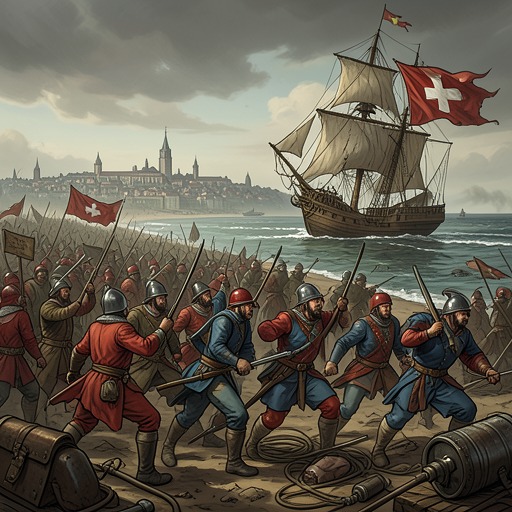
The conflict is international from the beginning. Spaniards, Englishmen, Italian malcontents, adventurers, and soldiers of fortune from different sects gather under the Protestant standard, forming a wide association whose branches extend across Europe. Against this network, the French royal army mobilizes troops from across the kingdom. After an initial engagement, Richelieu sends Monsieur to direct the first operations and orders every available force toward the theater of war. d'Artagnan, still serving in the Guards rather than among the Musketeers, forms part of this vanguard.
The royal advance is affected by the condition of the king himself. Louis XIII intends to follow after holding his Bed of Justice, but on June 28 he is seized by fever and must halt at Villeroy. Whenever the king stops, the Musketeers stop as well, leaving d'Artagnan temporarily separated from Athos, Porthos, and Aramis. He nevertheless reaches the camp before La Rochelle on September 10, 1627. The army’s timetable thus depends not only on strategic decisions but also on royal health and the symbolic movement of the monarch’s household troops.
Command Rivalries and Military Operations
The royal army’s command is divided among figures whose political and religious positions complicate military unity. Bassompierre and Schomberg, marshals of France, claim the right to command the army under Louis XIII, while Richelieu favors the Duc d'Angouleme as lieutenant general because he distrusts Bassompierre’s Protestant sympathies. To prevent the marshals from abandoning the army, separate commands are assigned. Bassompierre holds the ground north of the city between Leu and Dompierre; the Duc d'Angouleme commands the eastern sector from Dompierre to Perigny; and Schomberg occupies the southern sector from Perigny to Angoutin.
The distribution of quarters makes the army’s internal surveillance almost as important as its confrontation with the enemy. Monsieur is stationed at Dompierre, Louis XIII moves between Estree and Jarrie, and Richelieu establishes himself at the bridge of La Pierre. Each principal figure watches another: Monsieur observes Bassompierre, the king observes the Duc d'Angouleme, and Richelieu observes Schomberg. The arrangement exposes a central feature of the royal army: it is a military instrument governed through political suspicion, with command assignments shaped by religious affiliation and court calculation as much as by battlefield competence.
The French position is strengthened by the conditions in the English camp. English soldiers suffer from poor food, living on salt meat and bad biscuit, and many become invalids. Rough seas destroy small vessels along the coast, leaving the shore covered at each tide with the wrecks of pinnacles, roberges, and feluccas. The army can therefore expect the English force to weaken even without a direct assault. Yet when intelligence reports that the enemy is preparing another attack, Louis XIII chooses decisive action rather than passive endurance.
The resulting expedition succeeds. The English are driven back step by step, beaten in repeated encounters, and defeated while crossing the Isle of Loie. They are forced to re-embark, leaving two thousand men on the battlefield, including five colonels, three lieutenant colonels, two hundred and fifty captains, and twenty gentlemen of rank. The French capture four cannon and sixty flags, which Claude de St. Simon carries to Paris and displays with ceremony beneath the arches of Notre Dame. Te Deums are sung in the camp and throughout France, transforming a battlefield victory into a public demonstration of royal and ministerial power.
Siege Logistics and Wider War
The army’s success against the English removes the immediate danger to the siege, allowing Richelieu to continue the blockade with less fear of foreign relief. The decisive instrument is the dyke constructed by the cardinal, which prevents vessels from entering La Rochelle and drives the fish away into the open sea. Even an apparently minor exchange among the Musketeers registers the military consequences of this engineering project: at the Parpaillot, Aramis explains that the dyke has altered the local food supply, while the besiegers themselves complain of the scarcity of fish.
The blockade does not produce a quick surrender. La Rochelle remains invested despite the precautions taken, and the siege threatens to last a long time. The city’s mayor suppresses an attempted mutiny by hanging the mutineers; afterward, the population resolves to die of hunger, regarding starvation as slower and less certain than strangulation. The French royal army’s pressure is therefore exercised through encirclement, engineering, deprivation, and the control of maritime access as much as through open combat.
The campaign also creates new intelligence and diplomatic dangers. An envoy of the Duke of Buckingham, Montague, is captured, and evidence emerges of a league joining the German Empire, Spain, England, and Lorraine against France. Papers found in Buckingham’s abandoned lodging confirm the alliance and, in Richelieu’s account, compromise Mme. de Chevreuse and consequently the queen. The army’s battlefield victory thus opens into a broader security crisis: military occupation produces documents, prisoners, and political evidence, while the cardinal must interpret every report arriving from Europe.
Narrative Function and Significance
For d'Artagnan, the French royal army is both an opportunity and a source of isolation. He arrives before La Rochelle as an ambitious Guardsman hoping to enter the Musketeers, yet his assignment separates him from Athos, Porthos, and Aramis. In camp he feels cut off from his friends and reflects that neither love nor fortune has advanced. Mme. Bonacieux has vanished, while his hostility toward Richelieu has made him the enemy of a man before whom even the greatest figures in the kingdom tremble. Milady becomes another enemy, less powerful than the cardinal but still dangerous. The national campaign therefore does not suspend private conflict; it concentrates and magnifies it.
The army also links distant theaters into one political system. While d'Artagnan crosses from Dover to London in pursuit of Buckingham, traveling with Planchet despite knowing neither the city nor a word of English, the French campaign continues to determine the stakes of his mission. Buckingham’s presence in England, the English occupation of the Isle of Ré, the siege of La Rochelle, and the alliance uncovered through Montague all belong to the same Anglo-French struggle. The army’s actions make the novel’s supposedly personal adventures part of a transnational war involving ports, fleets, religious factions, intelligence, and court reputation.
The French royal army consequently embodies the tension between centralized monarchy and the older personal forms of aristocratic warfare. It is mobilized to destroy the last Huguenot refuge and to close La Rochelle against England, but its commanders quarrel, its soldiers depend on food and weather, and its elite troops measure themselves through individual courage. The institution advances the power of Louis XIII and Richelieu, yet the narrative repeatedly shows that this power must be negotiated through loyal captains, rival marshals, chosen guardsmen, military engineering, and information gathered across borders. Its decisive victory before La Rochelle is therefore not merely a military conclusion: it is the moment when private heroism, royal authority, religious repression, and the material machinery of early modern war become inseparable.